Ask Every Manufacturer: What Is It Really Made Of?
Before you buy, ask any manufacturer you’re considering to tell you exactly what their product is made of: the raw materials, the glues and the finishes. You should clearly know what any product you bring into your home is REALLY made of.
We’re happy to answer that question. Below you’ll find every material that goes into a Lundia system, along with the Safety Data Sheets for our finishes and glue.

Lundia Ingredients
Everything that goes into a Lundia system. That’s the whole list.
| Ingredient | Where it’s used |
|---|---|
| Solid Hardwood Maple | Frames, uprights, cross rails, drawer fronts, doors |
| Solid Premium White Pine | Shelves |
| Titebond wood glue | Joining solid wood boards into wider shelves and panels |
| ¼″ plywood with soy-based glue | Closed-end panels and drawer bottoms only |
| Sherwin-Williams Kem Aqua Plus | Water-based, low-VOC lacquer on finished products (optional) |
Ingredient 1
The Wood: Solid Hardwood Maple & Premium White Pine
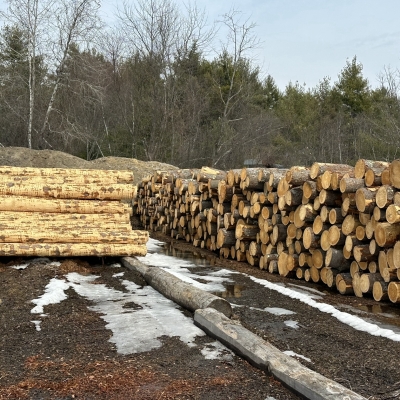
Every frame, upright, cross rail, drawer front and door is solid Hardwood Maple. Every shelf is solid Premium White Pine. Real lumber, cut from the tree and milled to size, with no chips, fibers or resin core.
Our lumber comes from New England forests in Merrimack and Hillsborough Counties, harvested by single tree selection: typically only 2 to 4 hand-selected trees per acre, which keeps the forest healthy and growing.
- Used for
- Maple: frames, uprights, rails, fronts, doors
Pine: shelves - Source
- New England single-tree harvest
- Formaldehyde
- No formaldehyde glue or resins

Ingredient 2
The Glue: Titebond Wood Glue
Trees aren’t wide enough to make a shelf from a single board, so we join solid boards edge to edge to make our wider shelves, uprights and panels. For that we use Titebond wood glue by Franklin International, which lists no hazardous ingredients on its Safety Data Sheet.
That’s a thin glue line between solid boards, not a resin binding millions of wood chips together.
- Used for
- Joining solid boards into wider pieces
- Maker
- Franklin International (Titebond)
- Safety Data Sheet
- View the SDS (PDF)
Ingredient 3
The Plywood: ¼″ with Soy-Based Glue
We use plywood in only two places: our closed-end panels and our drawer bottoms. It’s a thin ¼″ plywood made with soy-based glue instead of the formaldehyde-based glue found in standard plywood.
Everything else is 100% solid wood.
- Used for
- Closed-end panels and drawer bottoms only
- Thickness
- ¼″
- Glue
- Soy-based
Ingredient 4 (optional)
The Finish: Sherwin-Williams Kem Aqua Plus
Our clear and tinted finishes use Sherwin-Williams Kem Aqua Plus, a water-based, low-VOC lacquer. It has no IARC, NTP or OSHA listed carcinogen ingredients (see Section 11, Toxicological Information, of its Safety Data Sheet).
- Used for
- Clear and tinted finished products
- Type
- Water-based, low-VOC lacquer
- Safety Data Sheet
- View the SDS (PDF)
For chemically sensitive clients
Choose Unfinished: Nothing But Wood
If you’re sensitive to any chemicals, order your system unfinished, sanded smooth. With no lacquer at all, it’s just solid wood. You don’t have to finish it: solid wood will last a lifetime unfinished. Or finish it yourself, with any product you trust.
- Finish
- None, sanded smooth
- Chemicals
- None added
- Ideal for
- Allergies and chemical sensitivities
Even the box
Packaging: Biodegradable & Compostable
Our packaging is naturally biodegradable, compostable and recyclable. Under proper conditions it breaks down into organic wood fibers in about 2 to 3 months.
- Breaks down into
- Organic wood fibers
- Time to compost
- About 2 to 3 months
See for yourself
Safety Data Sheets & Documents
Safety Data Sheets (SDS) are standardized documents required by OSHA that list a product’s ingredients and hazards.
Our Closets are Green
Our Solid Wood Lumber comes from Single Harvest Forests
All of our lumber comes directly from Single Harvested Trees from New England Forests.
For over half a century Lundia USA has been manufactured using solid Hemlock for our frames and Ponderosa
Pine for our shelves. After years of consideration and research, we are proud to announce that all Lundia verticle
surfaces (Frames, cross rails, drawer fronts, doors) are now made out of beautiful Hardwood Solid Maple. All of our shelves
are now made out of premium White Pine. As always, it is REAL SOLID WOOD with the same incredible modularity!


Sustainable harvesting can be defined as a method of harvesting that provides a constant supply of wood resources throughout the landscape, with future timber yields unaffected or improved by current methods. Foresters emulate natural disturbances with their harvesting methods to maintain these balances.
Our lumber is harvested in these forests using "Single Tree Selection". Typically, the harvest is only 2 to 4 trees hand-selected per acre. This is the most responsible method of harvesting, protecting both forests and wildlife. Trees are inspected for nests before harvesting. If excessive bird droppings (White Wash) are observed around a tree base, it is avoided. This “Light Touch” approach maintains balance between vegetation and wildlife.


Our Solid Hardwood Maple and Premium White Pine before going into the mill and then during production in our factory (Absolutely NO particle board or melamine in our modular systems!)
Single Tree Harvesting makes for the Healthiest Forests:
- Improved tree growth: Removing a tree creates space and resources for surrounding trees, leading to more vigorous growth.
- Increased diversity: By creating canopy gaps, single tree selection encourages the regeneration of a mix of young and old trees and supports various species, including those that are shade-intolerant.
- Enhanced wildlife habitat: Opening the canopy allows more sunlight to reach the forest floor, which fosters the growth of shrubs and berries that provide food and shelter for many animals.
- Soil health: While it can cause some soil disturbance, when done carefully, single tree selection can maintain soil quality and biological activity similar to an unmanaged forest.
- Low visual impact: The removal of individual trees has a less dramatic impact on the forest's appearance compared to methods like clear-cutting.


We use a water-based lacquer that has NO IARC, NTP, or OSHA listed carcinogen ingredients (See Section 11 - Toxicological Information in our Safety Data Sheet (SDS)).

IMPORTANT: If you are still concerned about any chemical materials, you have the option to purchase our modular systems Unfinished Sanded Smooth. You do not have to finish our Solid Wood Products. They will last you a lifetime. In fact, most of our commercial installations throughout the US are all Unfinished (going back over 50 years to the early 1960s). You also have the option of applying your own finish.

Compare materials used by top closet manufacturers...
| Manufacturer | Core Material | Made with Formaldehyde? |
|---|---|---|
| Lundia USA | Solid WoodReal Solid Wood | NONatural |
| Easy Closets | Particle Boardcovered with fake wood print | Yes☠ |
| Closet World | Particle Boardcovered with fake wood print | Yes☠ |
| California Closets | Particle Boardcovered with fake wood print | Yes☠ |
| Closets by Design | Particle Boardcovered with fake wood print | Yes☠ |
| Container Store | Particle Boardcovered with fake wood print | Yes☠ |
| IKEA | Particle Boardcovered with fake wood print | Yes☠ |
| Closet Maid | Particle Boardcovered with fake wood print | Yes☠ |
Comparison based on publicly available product information for each company's primary laminated closet system, current as of October 2026. "Made with Formaldehyde" refers to particle board, MDF, or similar engineered-wood cores bonded with formaldehyde-based resins; it does not imply that any product exceeds federal (EPA TSCA Title VI) or California (CARB) emission limits. Product lines and materials change, and some manufacturers may offer other materials not listed here. All trademarks belong to their respective owners, who are not affiliated with or endorsing Lundia. If you believe any information here is inaccurate, please contact us and we will review and correct it promptly.