The Facts about the Dangers of Particle Board

Why allow one of the most toxic chemicals in the most confined space in your home?!

US EPA Logo

From the US EPA: What should I know about Formaldehyde and Indoor Air Quality?

In homes, the most significant sources of formaldehyde are likely to be pressed wood products made using adhesives that contain urea-formaldehyde (UF) resins. Medium density fiberboard contains a higher resin-to-wood ratio than any other UF pressed wood product and is generally recognized as being the highest formaldehyde-emitting pressed wood product.

In homes with significant amounts of new pressed wood products, levels can be three times the amount of older homes.

Current News regarding Formaldehyde

April 20, 2022

EPA Draws Link Between Low-Dose Formaldehyde Exposure and Cancer

April 14, 2022, U.S. EPA announces it will officially designate that Formaldehyde causes cancer, even in low doses over long periods of time. EPA’s 2018 National Air Toxics Assessment (NATA) data shows formaldehyde is one of the three air pollutants responsible for over 90 percent of the cancer risk related to air pollution in over a hundred census tracts.


CNN Health logo

December 5, 2024

Formaldehyde causes more cancer than any other toxic air pollutant. Little is being done to curb the risk

.....perhaps most worrisome, it often poses the greatest risk in the one place people feel safest: inside their homes.

The EPA’s own calculations show that formaldehyde exposure in those homes would cause as many as 255 cancer cases in every million people exposed over their lifetimes — and that doesn’t reflect the risk of myeloid leukemia.

NonToxicLab logo

Top Twelve Toxic Chemicals to Avoid

Listed at number 6: Formaldehyde

Health Effects
Formaldehyde causes nasopharyngeal cancer and leukemia. At lower exposures, it irritates eyes, nose, and throat, triggers asthma, and causes skin reactions. Children and people with asthma are particularly sensitive.

American Cancer Society Logo

From the American Cancer Society

NOTE: A substance that causes cancer or helps cancer grow is called a "Carcinogen".

  • National Toxicology Program (NTP): Identifies Formaldehyde as "Known to be a human carcinogen"
  • International Agency for Research on Cancer (IARC): Concludes that Formaldehyde is "Carcinogenic to Humans" based on higher risks of nasopharyngeal cancer and leukemia
  • EPA: Classifies Formaldehyde as "A Probably Human Carcinogen"
  • National Cancer Institute: Concludes that exposure to Formaldehyde may cause Leukemia, particularly Myeloid Leukemia

Will an organizer made of particle board actually release Formaldehyde Fumes in my Closet?

Quotes from the California EPA:

“For products that are made with formaldehyde-based resins or adhesives, rapid off-gassing of formaldehyde occurs initially when the product is made, and over time the formaldehyde emissions decrease.”
“An increase in temperature and humidity can increase formaldehyde emissions.”
“You may also leave your new product(s) in the garage for a few days to let it off-gas before bringing it inside.”
FEMA logo

$42.6 Million Class Action Settlement awarded to over 55,000 victims after exposure to Toxic Formaldehyde Fumes in trailers supplied by FEMA

These trailers were used to house displaced residents after Hurricane Katrina. The CDC confirmed the source of the formaldehyde fumes:

"Formaldehyde is used in a number of materials in the trailers, including the particleboard used to make walls and cabinets."

FEMA trailers caused at least 17,000 illnesses among Katrina survivors

"Some of the most seriously affected are infants and children, who have developed chronic asthma and require lifelong medical care. The cancer rates will not be known for at least a decade, according to health experts...... The chemical is emitted from glues and sealants used in construction materials such as particleboard....."

The Washington Post logo

Toxicity in FEMA Trailers Blamed on Cheap Materials (Particle Board)

Realtor.com logo

What Is MDF Board? A Hidden Health Hazard in Your Home

California EPA Cancer Risk Estimates

California's EPA report on Particle Board (PB) dated April 26, 2007 confirms:

"Childhood risk (9 years): 23-63 cancer cases per million" "Lifetime risk (70 years): 86-231 cancer cases per million"

CARB Compliant Particle Board Phase 1 will only reduce the cancer cases by 12 to 35 cases.


Compare Materials from Top Manufacturers

Manufacturer Core Material Made with Formaldehyde?
Lundia USA Solid WoodReal Solid Wood NONatural
Easy Closets Particle Boardcovered with fake wood print Yes☠
Closet World Particle Boardcovered with fake wood print Yes☠
California Closets Particle Boardcovered with fake wood print Yes☠
Closets by Design Particle Boardcovered with fake wood print Yes☠
Container Store Particle Boardcovered with fake wood print Yes☠
IKEA Particle Boardcovered with fake wood print Yes☠
Closet Maid Particle Boardcovered with fake wood print Yes☠

Comparison based on publicly available product information for each company's primary laminated closet system, current as of October 2026. "Made with Formaldehyde" refers to particle board, MDF, or similar engineered-wood cores bonded with formaldehyde-based resins; it does not imply that any product exceeds federal (EPA TSCA Title VI) or California (CARB) emission limits. Product lines and materials change, and some manufacturers may offer other materials not listed here. All trademarks belong to their respective owners, who are not affiliated with or endorsing Lundia. If you believe any information here is inaccurate, please contact us and we will review and correct it promptly.

Lundia Ingredients Solid Maple, Solid White Pine, wood glue, soy-glued plywood, optional water-based finish. Not inside: Particle board · MDF · Melamine · Formaldehyde resin See the full list

From the Forest to Your Closet

Two Ways to Make a Shelf

Every closet shelf starts as a tree. What happens next makes all the difference. Follow both paths, step by step, and see what really ends up in your home.

  1. 1The Raw Material
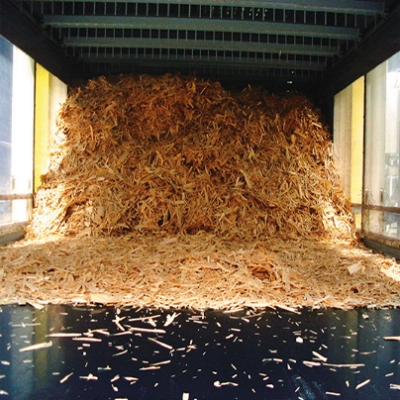
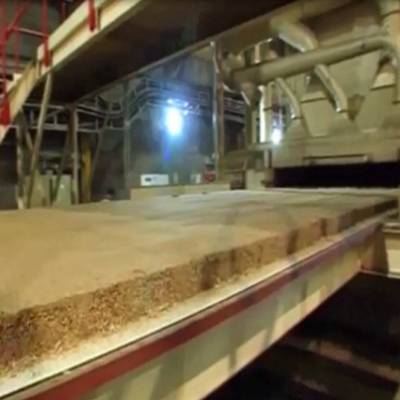
    A large pile of shredded wood particles inside a particle board plant
    Particle Board

    Shredded to Bits

    Random logs, sawmill scraps and leftover wood are shredded into tiny particles. The natural grain that gives wood its strength is gone.

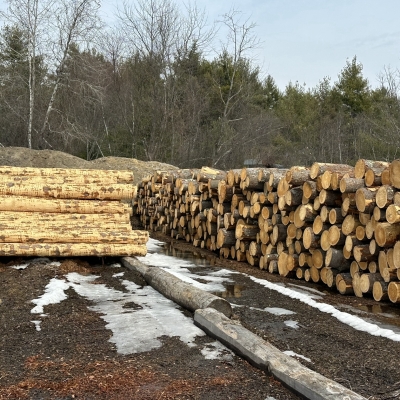
    Stacks of freshly harvested logs in the woods
    Lundia Solid Wood

    Single-Tree Harvested

    These are our actual logs. Trees are selected and harvested one at a time, so the wood that reaches you starts as real, whole timber.

  2. 2Making the Board
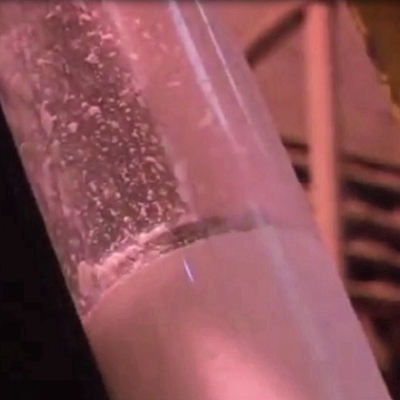
    A large clear tube carrying formaldehyde resin into wood particles
    Particle Board

    Mixed with Formaldehyde Resin

    This is an actual 2-foot-diameter tube injecting formaldehyde resin into the wood particles. That resin is the “glue” holding particle board together, and the source of the formaldehyde fumes it can release into your home.

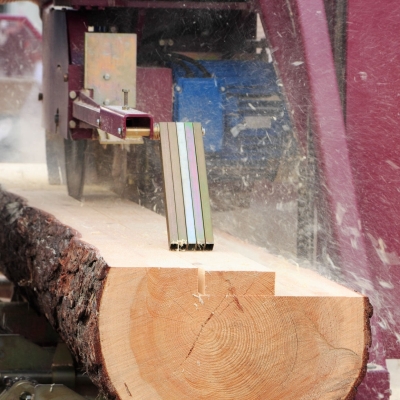
    A sawmill blade cutting a log into boards
    Lundia Solid Wood

    Cut & Milled

    Logs are cut and milled straight into usable boards. No shredding and no resin, just the tree’s own grain, kept whole.

  3. 3Forming the Panel
    A mat of wood chips and resin moving on a conveyor toward a heated press
    Particle Board

    “Baked” into Panels

    The mat of wood chips and formaldehyde resin is pressed under heat, essentially baked, into flat panels.

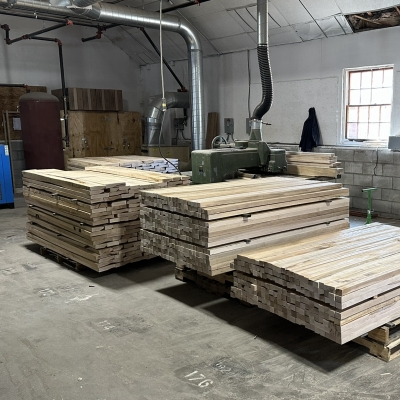
    Stacks of solid wood boards in the Lundia shop
    Lundia Solid Wood

    Ready for Our Shop

    Our actual solid wood, stacked and ready to be cut into shelves, uprights and the other solid wood components of your system.

  4. 4The Finished Shelf
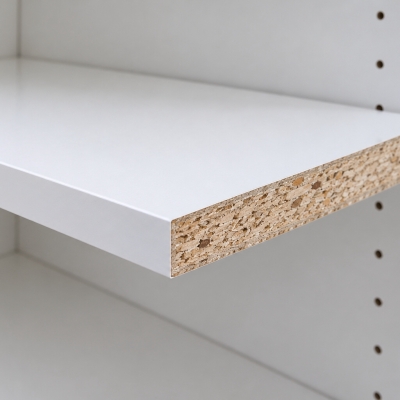
    A white laminated particle board shelf with the chip core exposed at the cut edge
    Particle Board

    A Printed Disguise

    Paper laminate and edge tape are applied to give it a printed wood-grain or solid-color finish. Underneath, it’s still wood chips and formaldehyde resin.

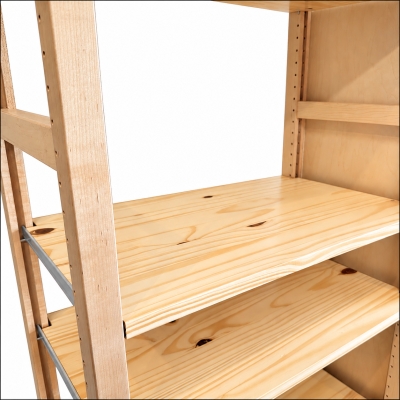
    A natural solid wood shelf supported by solid wood uprights
    Lundia Solid Wood

    Nothing to Hide

    Our natural solid wood shelf, supported by solid wood uprights. The grain you see is the real grain of the tree, all the way through.

What’s Really in the Shelf?

Particle Board
  • Shredded wood particles
  • Formaldehyde resin
  • Printed paper laminate
  • Edge tape
Lundia Solid Wood
  • Solid wood

That’s it.

Same closet. Two very different materials. Which one would you rather live with?

Design My Solid Wood Closet

Notice: All respective trademarks above are not associated or sponsoring Lundia in any way.

Learn how Lundia helps you avoid toxic materials. Get a Free Design